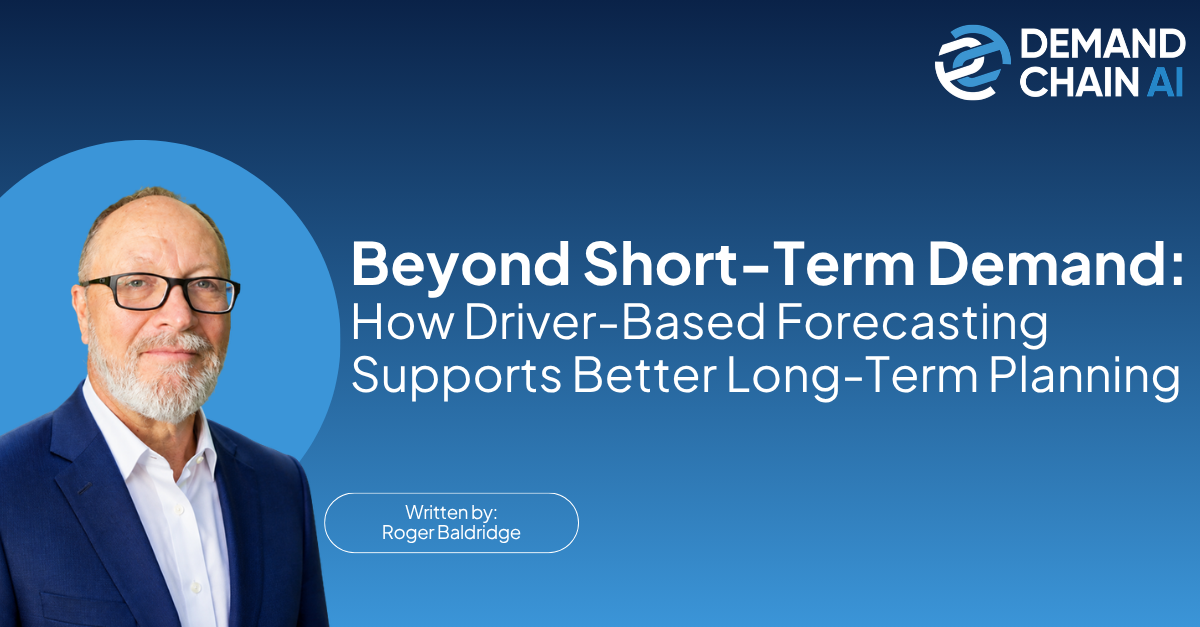
Written by: Roger Baldridge
For CPG companies, forecasting has traditionally focused heavily on historical demand. Looking at past sales provides an important foundation, but it does not always answer the questions businesses need to make longer-term decisions.
What will demand look like in the future? What decisions could impact our business strategy? What happens if market conditions shift?
These questions are becoming increasingly important as CPG companies make decisions around pricing, promotions, distribution, investment, and growth. Driver-Based Forecasting provides a way to bring those decisions and their potential impacts into the forecasting process.
Why Is Long-Term Forecasting Becoming More Important?
Long-term forecasting is an important part of developing business strategy and understanding potential future performance.
Companies need to understand more than expected sales. They also need to understand the financial expectations behind those sales and the drivers influencing the decisions that shape the business.
A longer-term view can help organizations consider how today’s decisions could affect future demand and performance. Rather than simply extending historical trends into the future, companies can consider the assumptions behind their forecasts and how changing those assumptions could affect the outlook.
This makes the forecast part of the broader strategic planning process rather than simply a projection of past performance.
What Business Drivers Have the Biggest Impact on Future Demand?
There isn’t one driver that determines future demand for every CPG company. Different businesses will have different factors that matter most, and it is the combination of those drivers that helps define the overall strategy.
Some of the most significant drivers can include:
- Promotion spend
- Pricing decisions
- Distribution and points of distribution
- Advertising and media spend
- Weather
- Macroeconomic indicators
For some businesses, weather may have a significant impact. For others, pricing, promotions, or distribution may be more influential.
The important question is not simply what happened to sales? But what factors contributed to that outcome, and how might those factors change?
This is one of the key differences between a traditional forecast and a driver-based approach. A traditional forecast can identify patterns in historical demand, while driver-based forecasting provides a way to incorporate the business and external factors that can influence future demand.
How Does Driver-Based Forecasting Help Identify Opportunities and Risks?
One of the biggest benefits of driver-based forecasting is the ability to change assumptions and create different scenarios.
Consider a company that is considering a price increase. The decision could increase revenue per unit, but it could also negatively affect distribution, which will in turn negatively impact demand. Instead of making the decision based on a single expected outcome, the organization could create a scenario that assumes a price increase along with a decrease in demand.
The company can then evaluate how those changes could affect their supply chain.
That analysis can be performed at different levels, whether looking at the overall business, a particular channel, or even a specific customer. The potential outcomes can also be considered in financial terms, providing a better understanding of how the decision could affect profitability.
This allows companies to compare possible outcomes before making a decision.
The purpose isn’t necessarily to predict exactly what will happen. It is to understand the potential impact of different decisions and identify which option provides the best chance of reaching the organization’s goal.
What Happens When Companies Rely Only on Historical Data or Short-Term Forecasts?
Historical data is valuable, but it represents what has already happened.
When companies rely primarily on historical data or short-term forecasts, they may have less visibility into how future business decisions could change demand. A forecast based largely on historical patterns may not fully reflect changes in pricing, promotions, distribution, customer behavior, market conditions, or other external factors.
Driver-based forecasting provides a way to incorporate those factors and evaluate different possible outcomes.
This can be particularly important when organizations are deciding between multiple options. Instead of choosing a decision based only on a single forecast, teams can compare scenarios and determine which option has the greatest or least impact on unit sales, or which option may provide the strongest financial outcome.
How Can Driver-Based Forecasting Improve Organizational Alignment?
Another important benefit of driver-based forecasting is organizational alignment.
Demand isn’t influenced by one department. Commercial decisions, customer feedback, market trends, and external factors can all affect the outlook.
Sales, Marketing, Finance, and Supply Chain may each have different information that influences their expectations for the future. If those assumptions aren’t connected, teams can end up working toward different versions of the plan.
A driver-based forecast provides a way to make those influences more visible and explainable.
Rather than simply providing a forecast number, the organization can see how different actions and assumptions are reflected in the forecast, and how different decisions from different departments may impact each other. Those impacts can then be measured against the data, giving teams a shared way to understand how their decisions are affecting demand.
Looking Beyond What Has Happened
Long-term forecasting isn’t about eliminating uncertainty. It is about having better visibility into the factors that create it.
Historical data can help companies understand where they have been, but long-term planning also requires consideration of where the business could go based on different decisions and market conditions.
Driver-based forecasting provides a framework for doing that by connecting demand to the drivers that influence it, allowing organizations to change assumptions, compare scenarios, and better understand potential outcomes.
Ultimately, the goal is to move beyond simply asking “What does the forecast say?”
The more useful questions may be:
“What is driving the forecast?”
“What could change it?”
“What happens if we make a different decision?”
And most importantly, “Which decision gives us the best chance of achieving our goals?”
That shift from forecasting what is most likely to happen toward understanding what could happen can give CPG companies a stronger foundation for long-term planning and better decision-making.